 By admin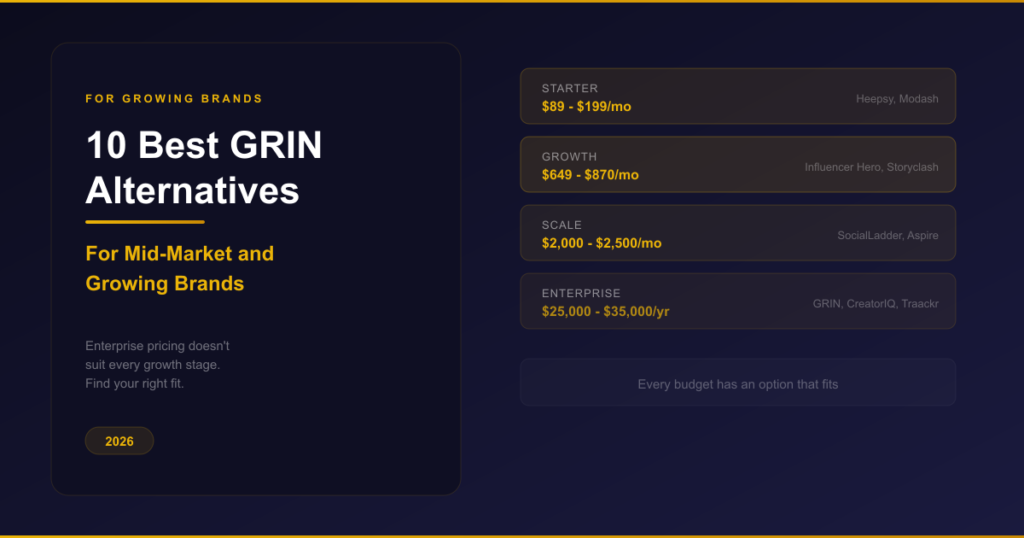
GRIN has carved out a strong position in the influencer marketing space, particularly for enterprise eCommerce brands running large-scale creator programs on Shopify. But its pricing model – starting at roughly $25,000 per year with a mandatory 12-month commitment – creates a real tension for mid-market brands and growing teams that need serious influencer marketing capabilities without committing to enterprise-level overhead.
For brands doing $5M to $50M in annual revenue, the math often doesn’t work. That $25,000 annual commitment could fund dozens of creator partnerships, test new channels, or support a full quarter of paid media. And the rigid annual contract means you’re locked in even if your strategy pivots, your team restructures, or a campaign vertical underperforms.
This guide covers ten platforms – starting with Influencer Hero – that deliver professional-grade influencer marketing tools at price points and contract structures better suited to mid-market realities. Whether you’re scaling from a scrappy gifting program to a full multichannel creator strategy, these alternatives offer the flexibility GRIN’s model doesn’t.
- Influencer Hero
- Modash
- Storyclash
- HypeAuditor
- Aspire
- Later
- Traackr
- Sprout Social
- CreatorIQ
Why Mid-Market Brands Are Outgrowing GRIN’s Pricing Model
GRIN is a capable platform with real strengths – unlimited creator partnerships, deep Shopify integration, and structured content workflows. But those strengths come packaged in an enterprise pricing model that creates friction for brands at the mid-market level:
- $25,000/Year Minimum With 12-Month Lock-In: For a brand spending $100K-$500K annually on influencer marketing, the platform cost alone represents a significant percentage of budget. Monthly payments are available, but you’re still committed for the full year regardless of results.
- No Published Database Size: Competitors openly index 200M to 450M+ creator profiles. GRIN doesn’t publish its database size, which makes it difficult to evaluate discovery capabilities upfront – a concern for brands exploring new verticals or international markets.
- Shopify-Heavy Ecosystem: GRIN’s deepest integrations are with Shopify. Brands on WooCommerce, Magento, BigCommerce, or Prestashop will find themselves working around the platform rather than with it.
- Enterprise-Grade Complexity: The platform is built for large teams managing hundreds of partnerships simultaneously. For mid-market teams of two to five people, the overhead of enterprise workflows can slow down execution rather than speed it up.
- Rigid Workflows: GRIN’s structured approach works well at scale but can feel inflexible for brands that need to move quickly, test new approaches, or adapt campaigns on the fly. Several users report that the platform “forces your team to work for the software” rather than the other way around.
None of this makes GRIN a bad platform. It makes it the wrong fit for brands whose budgets, team sizes, and operational needs sit below the enterprise tier.
GRIN Overview
GRIN has built its reputation on unlimited creator partnerships and a tightly integrated Shopify workflow. Brands that run large-scale gifting and affiliate programs through Shopify will find GRIN’s native fulfillment, discount code generation, and revenue tracking genuinely useful. The creator portal system – where influencers manage briefs, submit content, and track earnings through private dashboards – reduces the coordination overhead that typically bogs down programs with 100+ active creators.
The platform also handles media rights automatically during the booking process, maintains a searchable UGC library including expired Stories, and offers real-time ROI dashboards tying creator activity to revenue. For enterprise eCommerce brands with dedicated influencer teams and Shopify as their primary commerce platform, GRIN delivers a comprehensive workflow.
The challenge is that this enterprise-grade feature set comes with enterprise-grade pricing and commitment requirements. For mid-market brands evaluating their options, the alternatives below offer comparable or specialized capabilities at more accessible price points and with more flexible contract terms.
Best GRIN Alternatives for Growing Brands
1. Influencer Hero
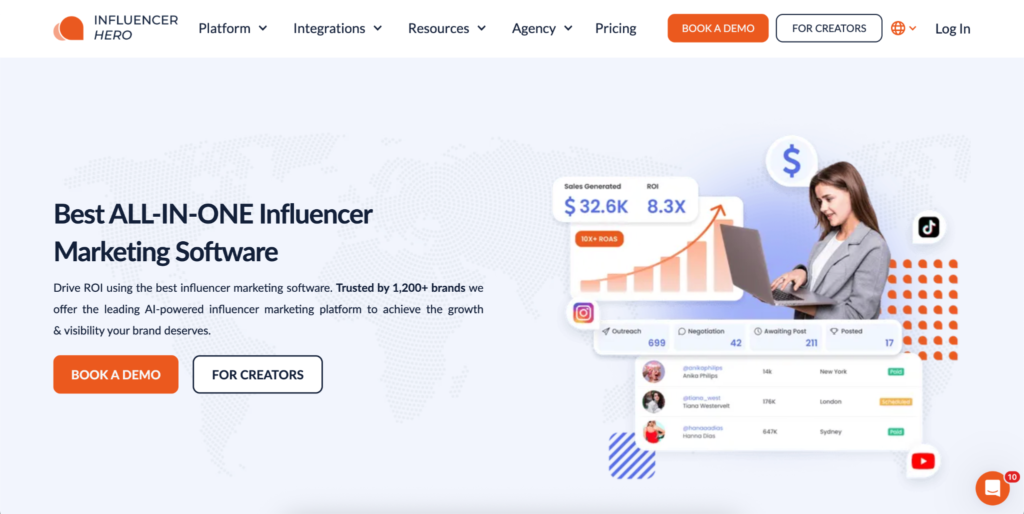
Influencer Hero is an all-in-one influencer marketing platform covering discovery, AI-powered outreach, CRM, product gifting, UGC collection, affiliate tracking, analytics, and creator storefronts – all within a single connected workflow. For mid-market brands, the value proposition is straightforward: you get enterprise-level capabilities without the enterprise price tag or contract lock-in.
The platform’s automation engine is where it pulls ahead for growing teams. Automated drip campaigns with AI-personalized first lines deliver a 43% average response rate, which means a small team can run outreach volumes that would typically require dedicated coordinators. The CRM includes rules-based triggers, auto deal progression, and Smart Deal Selection via AI prompts – automating the repetitive pipeline work that consumes time as programs scale. Five eCommerce integrations (Shopify, WooCommerce, Magento, BigCommerce, and Prestashop) mean you’re not locked into a single platform ecosystem, which is critical for mid-market brands that often operate across multiple storefronts.
Mid-market brands using the platform report results that validate the approach – one D2C brand scaled from $0 to $1.2M in revenue in a single year at 9.1x ROAS, while Olivida achieved 7.2x ROAS with a 150%+ reduction in average CAC. A free Chrome Extension lets teams evaluate creators directly from Instagram, TikTok, or YouTube with real-time analytics and one-click CRM import.
Best for: Mid-market brands that need a complete influencer marketing stack with AI automation, broad eCommerce support, and month-to-month pricing flexibility.
Pricing:
- Standard: $649/month (1 seat, up to 1,000 creators, 1,000 outreach/mo)
- Pro: $1,049/month (3 seats, up to 5,000 creators, 5,000 outreach/mo)
- Business: $2,490/month (8 seats, up to 10,000 creators, 10,000 outreach/mo)
- Custom & Agency plans available with unlimited outreach
- All plans include consultation and training
Standout features:
- 450M+ Creator Database Across 8 Platforms: The largest indexed database available – Instagram, TikTok, YouTube, Pinterest, Snapchat, Twitch, and X. Mid-market brands expanding into new verticals or geographies can source creators without third-party tools.
- AI-Powered Outreach (43% Response Rate): Automated drip campaigns with AI-generated personalized first lines. A two-person team can run outreach at a scale that typically requires dedicated coordinators.
- CRM With Automation Engine: Deal pages, conversation history, bulk actions, rules-based triggers, and Smart Deal Selection. The pipeline advances automatically as creators hit milestones.
- Five eCommerce Integrations: Shopify, WooCommerce, Magento, BigCommerce, and Prestashop – the broadest native eCommerce support on this list, critical for brands not locked into a single storefront.
- Creator Storefronts (Up to 8x ROI): Branded storefronts where creators sell products with affiliate commissions, turning partnerships into scalable revenue channels.
- Fraud Detection and Audience Authenticity: Built into the discovery workflow so teams can vet creators before committing budget to partnerships.
- Application Pages: Branded landing pages for inbound creator applications with automated approval workflows and three hosting options – reducing the manual outreach workload as programs grow.
- Payout Manager With Stripe: Streamlined creator payments with commission tracking, fixed fee support, creator dashboards for secure payment info, and full audit trails – replacing the spreadsheet-based payout processes common at mid-market scale.
The comprehensive feature set means teams adopting the platform for the first time should expect a brief onboarding period. The workflow-driven approach is built for scale, so very small brands running only a handful of campaigns may not use every capability immediately.
2. Modash
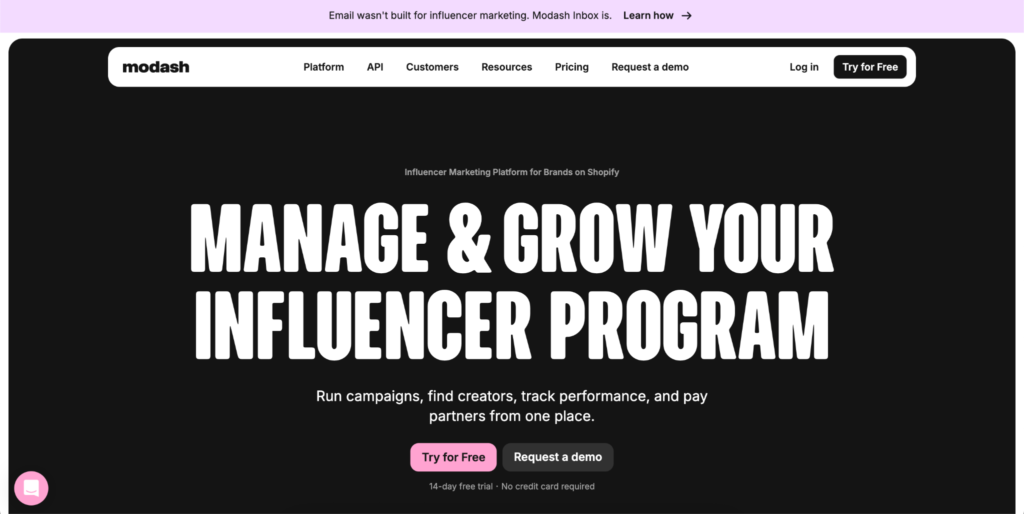
Modash offers one of the most accessible entry points for mid-market brands getting serious about influencer marketing. With 350M+ public creator profiles and month-to-month pricing starting at $199/month, it removes two of the biggest barriers that make GRIN inaccessible: cost and commitment. The platform pairs its massive database with Shopify-native affiliate workflows, making it particularly practical for eCommerce brands that want to move fast without negotiating enterprise contracts.
AI visual discovery is a standout feature – describe a visual style or upload a reference image to surface creators with matching aesthetics. For brands building a distinct visual identity, this is faster than filtering through keyword-based results. Built-in outreach with Gmail and Outlook sync keeps communication inside the platform, and automated affiliate payouts reduce the administrative overhead that grows as you scale partnerships.
Best for: Mid-market eCommerce brands on Shopify that want a large discovery database and affiliate tools with low-commitment, month-to-month pricing.
Pricing:
- Essentials: $199/month
- Performance: $499/month
- Enterprise: Custom
Standout features:
- 350M+ Public Creator Database: Non-opt-in profiles provide one of the widest discovery nets on the market, second only to platforms indexing 450M+.
- AI Visual Discovery: Describe a vibe or upload a reference image to find creators with matching aesthetics – faster than keyword-only filtering.
- Shopify-Native Gifting and Affiliates: Automated discount codes, UTM tracking, and product selection from Shopify catalogs.
- Automated Affiliate Payouts: Commission tracking and creator payments handled in-platform, reducing admin as partnerships scale.
- Month-to-Month Flexibility: No annual lock-in, so brands can scale spend up or down as campaigns evolve.
Modash’s deep integrations are Shopify-only – a significant limitation for brands on WooCommerce, Magento, or BigCommerce. The platform lacks native AI-powered outreach personalization, meaning manual effort increases linearly as you add more campaigns. Brands needing multi-platform eCommerce support and automated outreach at scale will want to evaluate platforms with broader integration coverage and AI-driven personalization.
3. Storyclash
Storyclash differentiates itself through content performance analytics and competitive intelligence. Mid-market brands competing for the same creator talent as larger competitors will appreciate the ability to see exactly which creators rival brands are working with and how those partnerships perform. This kind of intelligence directly informs strategy and helps smaller teams punch above their weight in creator negotiations.
The platform indexes 183M creator profiles and includes historical data on expired Stories, giving teams a deeper view into a creator’s track record than what’s publicly visible. AI-driven discovery supports keyword search, image recognition, and natural language prompts. Shopify integration tracks ROAS, CAC, and AOV at both the campaign and individual creator level.
Best for: Mid-market brands that use competitive intelligence and content performance data to inform their influencer strategy and creator selection.
Pricing:
- Business: starts at $870/month
- Enterprise: custom pricing
Standout features:
- Competitive Benchmarking: See which creators your competitors are hiring and how those campaigns perform – actionable intelligence for mid-market brands fighting for visibility.
- AI-Driven Discovery: Image recognition, AI prompts, and lookalike search for finding creators that match your brand’s visual identity.
- Historical Data Including Expired Stories: Access full content history for thorough creator vetting beyond what’s currently visible on profiles.
- Shopify ROAS Tracking: Campaign and creator-level ROAS, CAC, and AOV tracking for eCommerce performance measurement.
- Centralized Campaign Hub: Internal collaboration tools for team-based campaign management.
Storyclash lacks built-in contract generation and content licensing workflows, so those processes need to be managed separately. UGC repurposing rights require manual handling, which adds overhead at scale. Brands that need end-to-end workflow coverage – from outreach and CRM to licensing and fulfillment – may find platforms with integrated automation across all stages more efficient.
4. HypeAuditor
HypeAuditor has built its reputation as the gold standard for influencer auditing – fake follower detection, engagement quality analysis, and audience authenticity scoring. For mid-market brands where every creator partnership needs to deliver real results (not vanity metrics), HypeAuditor’s analytics add a layer of due diligence that most platforms treat as a secondary feature.
Beyond auditing, the platform includes AI discovery with lookalike search that reads captions and analyzes images, social listening for competitive monitoring, and Shopify integration for revenue attribution. Creator application pages and content approval workflows bring structure to campaign management.
Best for: Data-driven mid-market brands that prioritize audience authenticity and want the deepest available analytics on creator quality.
Pricing:
- Business: ~$10,000/year
- Enterprise: up to $60,000/year
Standout features:
- Advanced Audience Authenticity Analysis: Industry-leading fake follower detection and engagement quality scoring – the most thorough vetting available.
- AI Discovery With Lookalike Search: Reads captions and analyzes images to surface similar creators, efficient for expanding your roster in proven niches.
- Social Listening and Competitor Monitoring: Track hashtags, mentions, and competitor creator partnerships to inform strategy.
- Creator Application Pages: Branded pages where creators apply to your campaigns, streamlining inbound interest.
- Shopify Revenue Attribution: Connect creator performance directly to sales data for ROI measurement.
HypeAuditor is primarily an analytics tool, not a campaign execution platform. Only a small portion of influencers are registered for direct outreach through the platform, so brands will likely need to pair it with a separate outreach solution or an all-in-one platform that includes AI-driven outreach and CRM for running campaigns end to end.
5. Aspire
Aspire has built a distinct model around inbound creator recruitment – over a million creators actively apply to brand campaigns through its marketplace. For mid-market brands with enough recognition to attract creator interest, this inverts the typical cold-outreach grind and lets teams select from motivated applicants. First-party data integrations with Meta, TikTok, and Pinterest deliver reliable audience metrics.
The end-to-end workflow covers discovery, contracts, content approvals, and performance tracking. Deep Shopify integration supports gifting and automated fulfillment, and the asset library ties UGC to ROI reporting. Aspire positions itself as a comprehensive solution, though its pricing puts it closer to the enterprise tier.
Best for: Established mid-market brands with enough market recognition to attract inbound creator applications at scale.
Pricing:
- Custom; starts around $2,500/month
Standout features:
- Inbound Creator Marketplace: 1M+ creators applying to campaigns shifts the dynamic from cold outreach to curated selection.
- First-Party Social Data: Direct API integrations with Meta, TikTok, and Pinterest for reliable, audit-ready audience data.
- Structured Campaign Workflow: Discovery through tracking in a single pipeline with customizable approval stages.
- Shopify Fulfillment Integration: Creators select products directly from your catalog for gifting campaigns.
- UGC Library With ROI Attribution: Centralized asset repository tied to performance data for content repurposing decisions.
Aspire’s ~$2,500/month starting price and custom-only pricing structure limits budget predictability for mid-market teams. The inbound model works best for recognizable brands – newer or niche brands will still need strong outbound capabilities. Teams that rely heavily on cold outreach should evaluate platforms with AI-powered personalization and larger creator databases for better results at scale.
6. Later
Later expanded from social media scheduling into influencer marketing, and for mid-market brands that already use Later for content planning, adding influencer management into the same ecosystem has obvious workflow advantages. The ability to align influencer deliverables with your brand’s content calendar in one platform reduces the coordination overhead between social and creator teams.
Custom application pages let brands vet creators before onboarding them to campaigns, and AI-powered brand safety tools add a layer of content review. Later also offers managed and full-service options for brands that want to outsource campaign execution while maintaining platform access for oversight.
Best for: Mid-market brands already using Later for social media management that want to consolidate influencer marketing into the same platform.
Pricing:
- Social management tiers: Starter $25/month, Growth $50/month, Scale $110/month
- Influencer marketing plans: ~$28,500/year
Standout features:
- 15M Contactable Creators: Verified emails attached to creator profiles reduce the sourcing step for outreach.
- Content Calendar Integration: Align influencer deliverables with scheduled brand content in a unified planning view.
- Custom Application Pages: Branded creator vetting pages for structured campaign onboarding.
- AI-Driven Brand Safety: Automated content review tools flag potential issues before content goes live.
- Managed Service Options: Full-service campaign management for brands that want execution support alongside platform access.
Later’s influencer marketing plans start at ~$28,500/year – comparable to GRIN’s pricing and a significant commitment for mid-market budgets. The creator database of 15M is substantially smaller than platforms indexing 200M to 450M+ profiles, which limits discovery for niche verticals. Entry-level social tools overlap with much cheaper scheduling platforms, so the value really depends on using the full influencer marketing suite.
7. Traackr
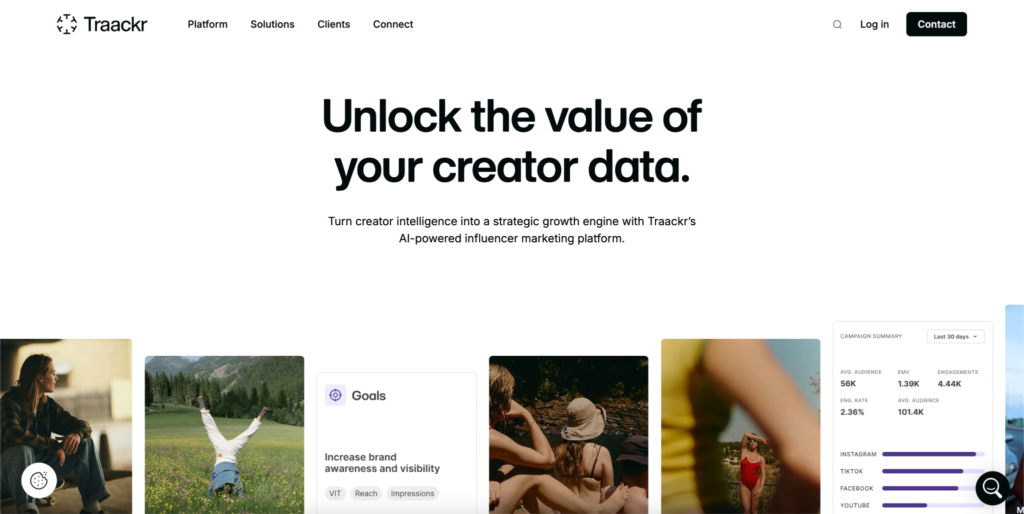
Traackr is built for brands that treat influencer marketing as a measurable performance channel rather than a creative experiment. Its Brand Vitality Score (BVS) – a proprietary metric measuring brand visibility, trust, and influence – gives mid-market brands a benchmark they can track over time and present to leadership as a concrete KPI, not just a collection of campaign-level metrics.
Cross-market analytics standardize reporting across languages and regions, which is useful for mid-market brands expanding internationally. Competitive insights reveal how rivals are allocating influencer budgets and which creators they’re partnering with, helping teams make more informed spend decisions.
Best for: Data-driven mid-market brands that need performance benchmarking and budget optimization tools to justify and allocate influencer marketing spend.
Pricing:
- Starts at ~$32,500/year, annual only (no monthly option)
Standout features:
- Brand Vitality Score (BVS): Proprietary metric for tracking brand visibility and influence over time – a concrete KPI for leadership reporting.
- Advanced Performance Reporting: CPC, CPE, CPV, ROI analysis with historical benchmarking across campaigns and time periods.
- Cross-Market Analytics: Standardized reporting across languages and regions for brands expanding internationally.
- Competitive Budget Insights: See how competitors allocate influencer spend and which creators they partner with.
- Automated Approval Workflows: Structured deliverable tracking with approval stages for content oversight.
Traackr’s $32,500/year starting price with annual-only commitment is actually more expensive than GRIN, making it a sideways move rather than a cost reduction for mid-market teams. The platform excels at measurement and strategic planning but doesn’t offer the same depth of outreach automation, CRM workflows, or eCommerce integrations found in all-in-one platforms. Brands needing tactical execution tools alongside analytics will need to supplement Traackr with additional software.
8. Sprout Social
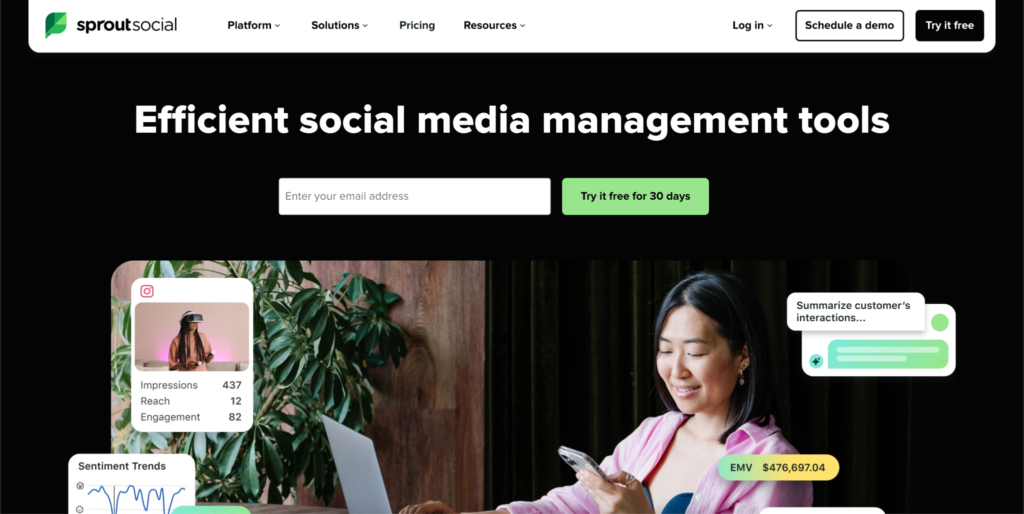
Sprout Social brings influencer marketing capabilities into its established social media management and analytics suite. For mid-market brands that already rely on Sprout for social publishing, community management, and reporting, adding influencer management into the same ecosystem consolidates tools and data. The Brand Fit Score automates creator vetting based on audience alignment and engagement quality.
Granular audience and engagement filters support discovery, while advanced approval workflows ensure content oversight before anything goes live. Competitive benchmarking and earned media value (EMV) reporting round out the analytics, and client-ready exportable dashboards are useful for brands reporting to investors or boards.
Best for: Mid-market brands already invested in Sprout Social’s ecosystem that want influencer marketing integrated into their existing social analytics and publishing workflow.
Pricing:
- $1,599/user/month, 12-month minimum
Standout features:
- Brand Fit Score: Automated creator vetting based on audience alignment, engagement quality, and brand relevance.
- Integrated Social Analytics: Influencer performance data alongside organic social metrics in a unified dashboard.
- Advanced Approval Workflows: Structured content oversight processes with multi-stage approvals.
- Competitive Benchmarking and EMV: Track earned media value and benchmark performance against competitors.
- Exportable Dashboards: Client-ready and board-ready reporting without manual reformatting.
Sprout Social’s per-user pricing at $1,599/month per seat makes it one of the most expensive options for teams. A three-person mid-market team would pay nearly $4,800/month – close to $58,000/year – before adding any other tools. The platform lacks vibe-based visual search and UGC licensing capabilities. Mid-market brands looking for dedicated influencer marketing tools with deeper CRM automation and broader eCommerce integrations at lower per-seat costs will find more purpose-built alternatives.
9. CreatorIQ
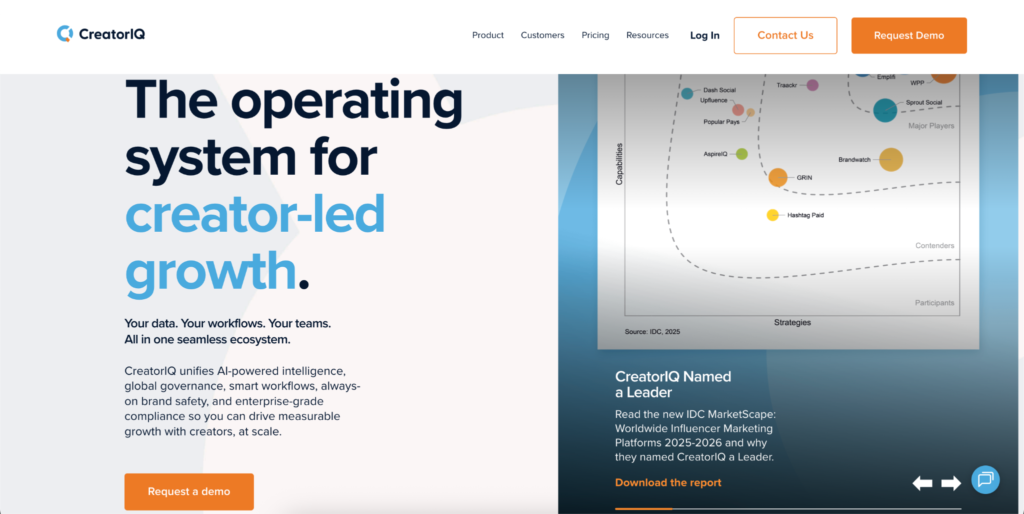
CreatorIQ sits at the enterprise end of the market, purpose-built for global brands managing influencer programs at massive scale. AI discovery with advanced semantic search, direct API integrations with Meta, TikTok, and YouTube for verified data, and executive-level reporting dashboards make it a command center for large organizations. International payments, tax documentation, and compliance handling support multi-market operations.
For mid-market brands, CreatorIQ is worth understanding as an aspirational benchmark – the kind of platform you might grow into. Its advanced CRM features, structured approval workflows, and brand mention tracking represent what enterprise-scale influencer marketing operations look like.
Best for: Enterprise brands and large organizations with dedicated influencer teams and budgets that support $35,000+ annually in platform costs.
Pricing:
- Starts at $35,000/year
- Enterprise tiers scale significantly higher
Standout features:
- AI Semantic Discovery: Advanced search that understands content context and brand mentions, not just keywords.
- First-Party Verified Data: Direct API integrations with Meta, TikTok, and YouTube for reliable audience and performance data.
- International Payment Compliance: Tax documentation and payout handling across jurisdictions for global campaigns.
- Executive Reporting Dashboards: Live performance dashboards designed for leadership and stakeholder presentations.
- Structured Approval Workflows: Multi-stage content review processes with role-based access controls.
CreatorIQ’s $35,000/year starting price is even higher than GRIN’s, making it a step up in cost rather than a budget-friendly alternative. The platform is built for organizations with dedicated influencer marketing teams and significant budgets. Mid-market brands looking for comparable CRM depth and automation capabilities at more accessible price points should evaluate all-in-one platforms with tiered pricing that scales with growth.
Final Thoughts
The influencer marketing platform market has matured significantly, and mid-market brands no longer have to choose between enterprise tools they can’t afford and entry-level products they’ll outgrow in six months. The nine alternatives covered here span a wide range of specializations and price points, and the right choice depends on where your brand sits today and where it’s headed.
A few guiding principles for mid-market teams evaluating their options:
- Match the contract to your planning horizon: Annual lock-ins make sense for brands with stable, predictable influencer budgets. Month-to-month options – like those offered by Influencer Hero and Modash – give growing brands the flexibility to scale spend with results rather than forecasts.
- Evaluate total cost, not just starting price: A $199/month platform that requires three add-on tools can cost more than a $649/month all-in-one platform that covers discovery, outreach, CRM, and affiliate tracking natively.
- Prioritize eCommerce fit: If your store runs on WooCommerce, Magento, or BigCommerce, Shopify-only integrations create workarounds that eat into the efficiency gains the platform is supposed to deliver.
- Don’t overbuy for your current stage: A $35,000/year platform is only worth it if your influencer program generates enough ROI to justify the cost. Mid-market brands often see better returns by investing in creator partnerships rather than platform overhead.
It’s also worth noting that many influencer marketing agencies use these same platforms to manage campaigns at scale for their clients – which speaks to the professional-grade capabilities available at mid-market price points. The right platform should grow with your brand, not force you to overcommit before your program has proven its value.
FAQs
1. What is the best GRIN alternative for mid-market eCommerce brands?
Influencer Hero offers the closest feature parity to GRIN – discovery, outreach, CRM, gifting, affiliate tracking, and analytics – at a lower price point with month-to-month flexibility. Its five eCommerce integrations (Shopify, WooCommerce, Magento, BigCommerce, Prestashop) also give it an edge over GRIN’s Shopify-focused ecosystem.
2. How much does GRIN cost compared to alternatives?
GRIN starts at approximately $25,000/year with a mandatory 12-month commitment. Alternatives range from $199/month (Modash) to $35,000/year (CreatorIQ). Mid-market options like Influencer Hero ($649/month) and Storyclash ($870/month) offer month-to-month or more flexible billing at significantly lower annual costs.
3. Can I get GRIN-level features without a 12-month contract?
Yes. Influencer Hero and Modash both offer month-to-month pricing with no annual lock-in. Influencer Hero’s feature set – including CRM, AI outreach, gifting, affiliate tracking, and UGC collection – covers the same workflow stages as GRIN without requiring an annual commitment.
4. Which platforms work with eCommerce stores beyond Shopify?
Influencer Hero supports five eCommerce platforms: Shopify, WooCommerce, Magento, BigCommerce, and Prestashop. Most other platforms on this list are either Shopify-only for deep integrations or require third-party connectors like Zapier for other storefronts.
5. Is GRIN worth it for a mid-market brand?
It depends on your scale and Shopify dependency. If you’re running 100+ active creator partnerships through Shopify and can justify $25,000/year in platform costs, GRIN delivers a strong enterprise workflow. For brands with smaller programs, mixed eCommerce platforms, or tighter budgets, the alternatives on this list offer comparable capabilities at more accessible price points.
6. What should mid-market brands prioritize when choosing an influencer marketing platform?
Focus on four areas: pricing flexibility (month-to-month vs annual lock-in), eCommerce compatibility (does it integrate with your storefront), automation depth (AI outreach, CRM triggers, automated workflows), and database size (larger databases mean more discovery options for niche verticals). A platform that covers all four reduces the need for supplementary tools.
Keywords: GRIN alternatives, GRIN alternatives for mid-market brands, influencer marketing platforms for growing brands, best GRIN competitors, Influencer Hero vs GRIN, affordable influencer marketing tools, mid-market influencer platform comparison, GRIN pricing alternatives